

READy+
Every child who struggles to read or count is stuck on a skill. READy+ shows the teacher which skill, and gives the teacher the activities to close the gap.
READy+ is LeapEd’s literacy and numeracy programme for primary schools. Teachers screen every child, give the ones who need a closer look a one-to-one diagnostic in Bahasa Malaysia, English, or mathematics, and see on one dashboard which skill is holding each child back. A toolkit of ready-made activities, training, and coaching through the year help them teach to that skill, and the same assessment at the end of the year shows what changed. READy+ has run in 384 primary schools across Malaysia: 249 under the government’s Programme Anak Kita in Selangor, CIMB Foundation’s Sekolah Angkat MADANI schools, ten rural primary schools in Kelantan, also under Sekolah Angkat MADANI, and 120 schools sponsored by one of our Financial Education Network (FEN) partners.
- 384primary schools, so farLeapEd programme records, October 2026
- 1,755teachers trainedLeapEd programme records, October 2026
- 16,011pupils reachedLeapEd programme records, October 2026
- 86%of children who started in the red were out of it on at least one skillREADy+ Student Impact Dashboard, 2026
- 97%of schools improvedREADy+ Impact Report, April 2026
- 9.5 / 10teachers' rating of READy+, ten Kelantan schools, 2026Teacher survey, ten rural primary schools, Kelantan, 2026, 49 teachers
Figures as at October 2026.
Why children stay behind in reading and maths
At the end of primary school, 42% of Malaysian children cannot read a simple text with understanding. That is the World Bank’s 2024 figure, and every school already knows which of its children are in it. The national screening test places them in a remedial group.
What the screening test does not show is why. Reading is a ladder of skills: understanding spoken language, knowing the letters, hearing the sounds inside words, decoding new words, reading fluently, and understanding what was read. Each rung depends on the one below. A child who cannot yet hear the sounds in a word will not decode it, and a child who cannot decode will never read fluently, however many comprehension lessons they sit through.
Counting is a ladder too: recognising numbers, telling which of two is bigger, finding the missing number in a sequence, adding and subtracting, and solving a problem written in words. A child who cannot yet read the problem cannot show what they can calculate, and a child still unsure of the numbers themselves cannot add them, however many worksheets they are given.
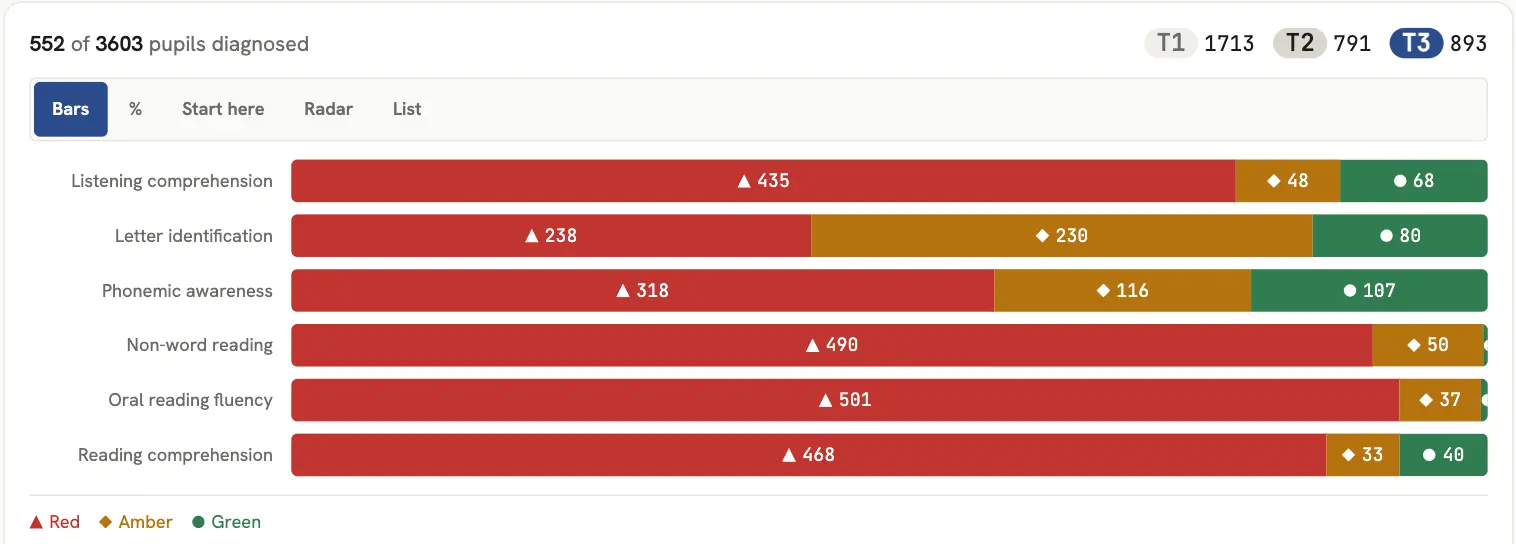
When READy+ assessed pupils at the start of the year in 249 Selangor schools, 4,892 of them had at least one English reading skill in the red. Of those, 4,609 could not yet read a short passage aloud. A child who cannot read the passage cannot learn comprehension from it, however many comprehension lessons they sit through. The teacher could see that the child was behind. Nobody could see where.
Every year a child stays stuck, the gap to the curriculum widens, and the cost of closing it grows.
How READy+ works
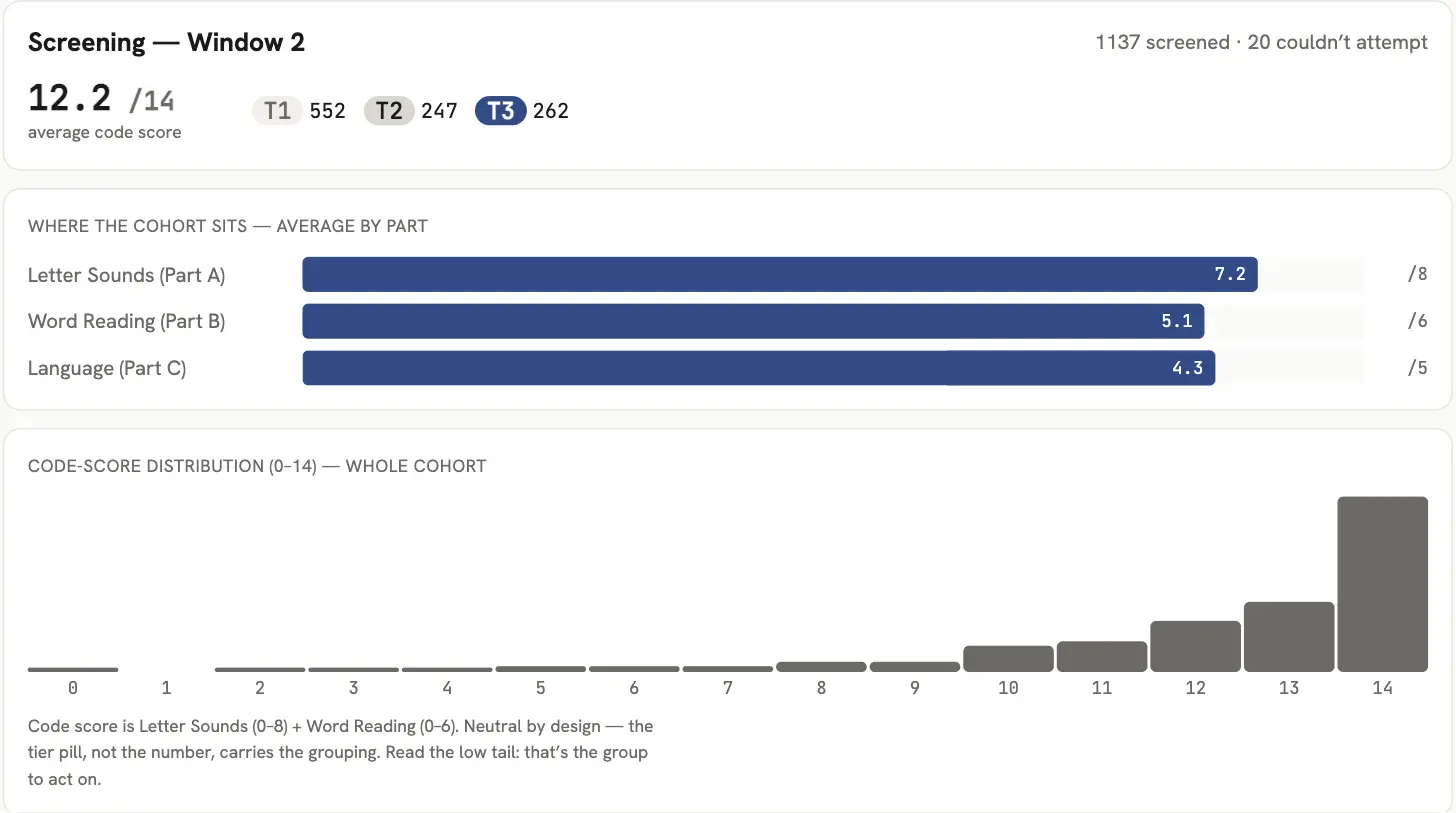
- Screen every child. At the start of the year, teachers run a short screen with every pupil in the subject the programme covers for that school, whether Bahasa Malaysia, English, or mathematics, or all three. The dashboard groups the pupils into three tiers. Only the lowest tier goes on to the next step.
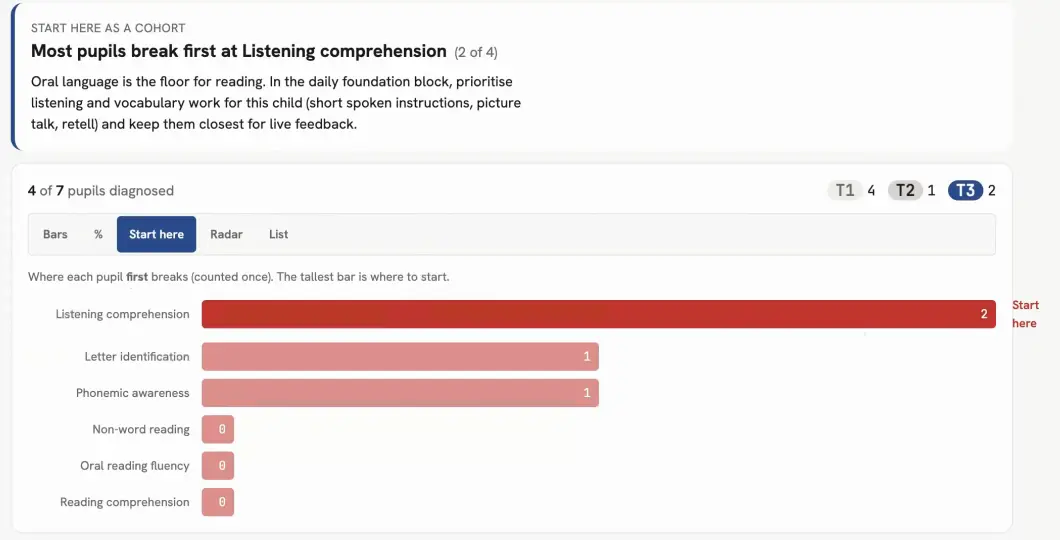
- Diagnose, one to one. For each child the screen flags, the teacher runs a one-to-one diagnostic, and the dashboard builds that child’s profile: every reading or maths skill in the order children learn them, each marked red, amber, or green. The first red skill is marked “Start here”, and the skills after it are greyed out, because each depends on the one before. The teacher sees the exact skill blocking that child, and the point to start teaching.
| Bahasa Malaysia | English | Mathematics |
|---|---|---|
| Listening comprehension | Listening comprehension | Number recognition |
| Letter recognition | Letter identification | Number discrimination |
| Phonological awareness | Phonemic awareness | Missing number |
| Non-word reading | Non-word reading | Addition and subtraction, two levels |
| Oral reading fluency | Oral reading fluency | Problem solving |
| Reading comprehension | Reading comprehension |
One scale for every skill. Red, 0 to 4: not yet mastered, taught first. Amber, 5 to 7: partly there, practised and checked. Green, 8 to 10: secure.
-
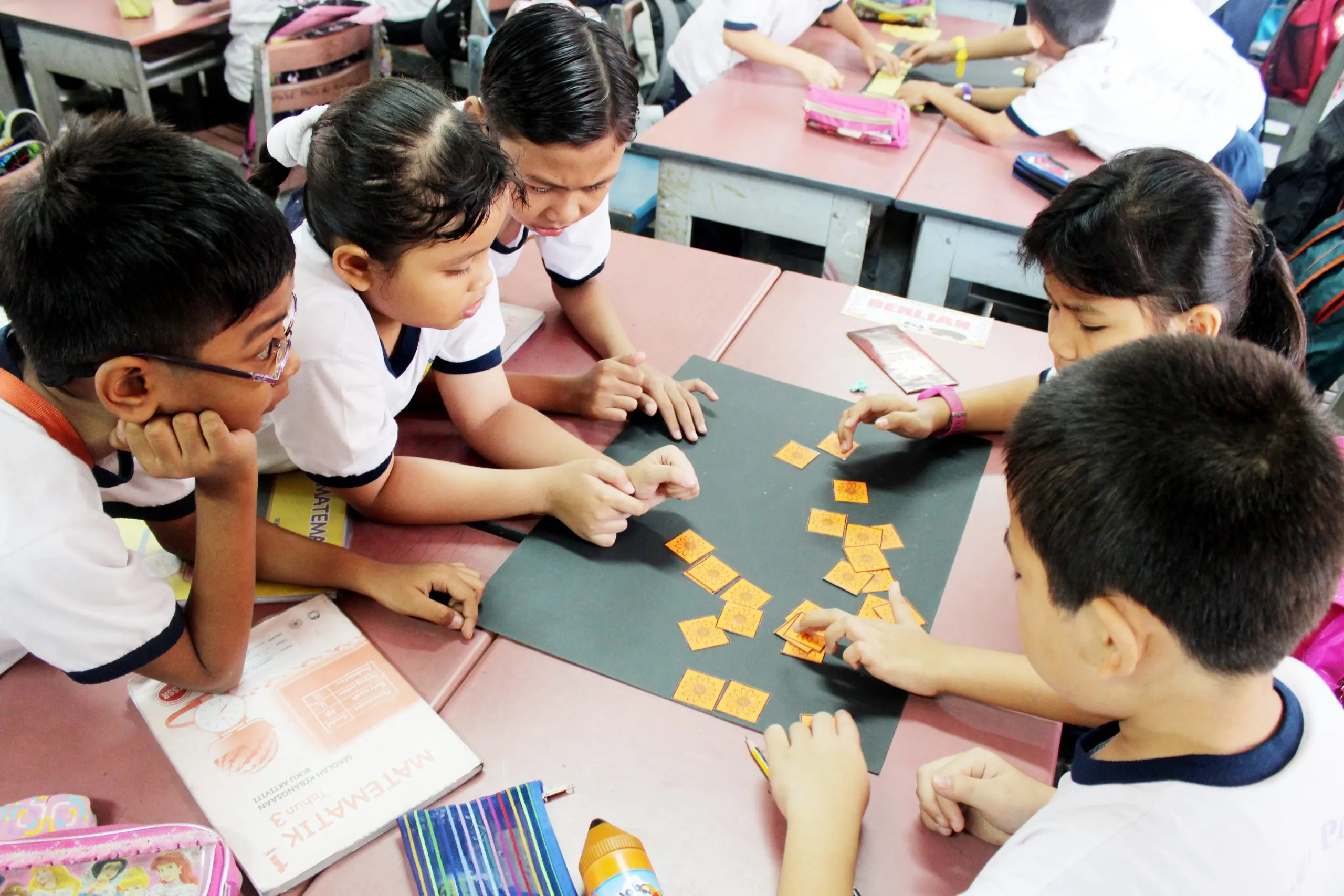
Teach to the gap. The READy+ toolkit gives the teacher activities matched to that skill and that child’s level, with hands-on materials that make the practice active and enjoyable. LeapEd trains and coaches the teachers through the year.
-
Check and adjust. Every six to eight weeks, teachers check each child’s progress and change what comes next.
-
Measure again. At the end of the year, the same skills are assessed again with the same children, so the change is clear, child by child and school by school.
The school’s own teachers run every assessment. LeapEd trains them, coaches them, runs professional learning communities with them, supplies the toolkit, and checks the data. Pupil-level data stays with the school under the Personal Data Protection Act. Sponsors and school leaders see school and year-group results.
Ready-made for busy teachers
The toolkit. For every reading and maths skill on the diagnostic there is a set of short activities, in Bahasa Malaysia, English, and mathematics, with the materials list and the steps. Letter tiles for the sounds a child is stuck on, number cards and counters for the numbers. Teachers do not need to be literacy or numeracy experts to use it, and they do not need new lesson plans. Most teachers use one or two activities a week for each focus area, then repeat them for several weeks with different content.
Training and coaching. Two cycles in the year, each with a workshop, two professional learning community sessions, and coaching visits in between. The school’s remedial teacher, its heads of panel for Bahasa Malaysia, English, and mathematics, and its counsellor train together, so remedial work stops being one teacher’s job.
Materials. Letter tiles, number cards, and the other hands-on resources the activities call for. In sponsored programmes a materials grant pays for them.
The dashboard. An account for every teacher and panel head, with access limited to their own pupils. Scores upload from a spreadsheet, so nobody keys in results by hand. No national identity numbers are held anywhere in the system.
What changed
In Selangor, 86% of children who started the year with a reading or maths skill in the red were out of it on at least one skill by November: 8,817 of 10,299. All eight districts improved in all three subjects, and 241 of the 248 schools with results improved.
In mathematics, 3,931 pupils were measured at the start and end of the year and moved from 4.96 to 7.13 out of 10. The biggest gain of any skill in the programme was in maths problem solving, from 2.44 to 7.08. Word problems have to be read before they can be solved, and children who could now read them solved them. In Bahasa Malaysia, reading comprehension gained more than any other skill.
In ten rural primary schools in Kelantan, measured over six months in 2026, 83% of pupils who started in the red on a skill were out of it on at least one skill: 344 of 414. In mathematics, the share of pupils in the green band rose from 19% to 54%.
In every one of the 27 schools where pupils were interviewed, children described moving from fear to confidence. In one school, teachers reported pupils arriving early because they wanted to get into the remedial class.
In the ten Kelantan schools, teachers rated READy+ 9.5 out of 10 at the end of the programme, and nine in ten said they intend to carry on using the diagnostics, the data, and the toolkit.
What teachers say
I would describe the toolkit as a "blessing in disguise" for teachers overwhelmed with workload. It offers ready-to-use printable resources and the suggested materials, which can conveniently be purchased using the provided grant. Thanks to this programme, I have my very own toolbox which consists of ready to do activities in classroom. 10 out of 14 pupils were able to read simple sentences.
 Kamini a/p S Selvaindran, English teacher, SK Pelabuhan Klang
I would describe the toolkit as a "blessing in disguise" for teachers overwhelmed with workload. It offers ready-to-use printable resources and the suggested materials, which can conveniently be purchased using the provided grant. Thanks to this programme, I have my very own toolbox which consists of ready to do activities in classroom. 10 out of 14 pupils were able to read simple sentences.
Kamini a/p S Selvaindran, English teacher, SK Pelabuhan KlangREADy+ · 2026
Student weaknesses can be detected earlier and early intervention can be provided.
 Teh Zhen Kiat, Mathematics teacher, SJK(C) Sungai Buloh
Student weaknesses can be detected earlier and early intervention can be provided.
kelemahan murid dapat dikesan dengan lebih awal dan memberi intervensi awal.
Teh Zhen Kiat, Mathematics teacher, SJK(C) Sungai BulohREADy+ · 2026
Before we started using the READy+ programme, identifying remedial pupils was mostly based on teacher observations and classroom assessments. Although we could see which pupils were struggling, we didn’t have enough detailed information about their specific weaknesses. … With the READy+ diagnostic tool, we are now able to clearly see the specific areas where each pupil needs help. … Pupils are more engaged and show more interest in learning. Teachers are working better as a team and feel more supported with clear materials and strategies.
 Head of English, Selangor
Before we started using the READy+ programme, identifying remedial pupils was mostly based on teacher observations and classroom assessments. Although we could see which pupils were struggling, we didn’t have enough detailed information about their specific weaknesses. … With the READy+ diagnostic tool, we are now able to clearly see the specific areas where each pupil needs help. … Pupils are more engaged and show more interest in learning. Teachers are working better as a team and feel more supported with clear materials and strategies.
Head of English, SelangorREADy+ · 2026
Since joining READy+, remedial pupils have shown more self-confidence and are braver about trying reading activities, even though they still make mistakes. As the Guidance and Counselling Teacher, I see that they are more ready to ask for help and do not give up easily when they meet difficulties. For example, pupils who used to be shy about reading in front of their friends are now starting to try, with the teacher's guidance and encouragement.
Cikgu Ooi Cheah Shin, School counsellor, SJK(C) Pui YingSince joining READy+, remedial pupils have shown more self-confidence and are braver about trying reading activities, even though they still make mistakes. As the Guidance and Counselling Teacher, I see that they are more ready to ask for help and do not give up easily when they meet difficulties. For example, pupils who used to be shy about reading in front of their friends are now starting to try, with the teacher's guidance and encouragement.
Sejak menyertai READy+, murid pemulihan menunjukkan peningkatan keyakinan diri dan lebih berani mencuba aktiviti membaca walaupun masih melakukan kesilapan. Sebagai Guru Bimbingan dan Kaunseling, saya melihat mereka lebih bersedia meminta bantuan dan tidak mudah berputus asa apabila menghadapi kesukaran. Contohnya, murid yang sebelum ini malu membaca di hadapan rakan kini mula mencuba dengan bimbingan dan galakan guru.
Cikgu Ooi Cheah Shin, School counsellor, SJK(C) Pui YingREADy+ · 2026
Pupils realise that learning can happen in an enjoyable atmosphere.
Malay teacher, KlangPupils realise that learning can happen in an enjoyable atmosphere.
Murid sedar bahawa pembelajaran boleh berjalan dalam suasana yang menyeronokkan.
Malay teacher, KlangREADy+ · 2026
Where it has run
READy+ began in 2024 as one of the initiatives under Program Anak Kita, the national programme run jointly by the Ministry of Education and the Ministry of Finance, with funding from Yayasan Hasanah. Over one school year it ran in 249 primary schools across eight districts of Selangor. CIMB Foundation has run it in its Sekolah Angkat MADANI schools. In 2026 it has run in ten rural primary schools in Kelantan, also under Sekolah Angkat MADANI, and in 120 primary schools across seven states, sponsored by one of our Financial Education Network (FEN) partners. In all, 384 primary schools so far.
Two ways to bring READy+ to a school
For sponsors: one school, one year, one number you can report
Choose a school, a district, or a state. It can be a school you already support, or we can tell you which schools need it most. Its teachers screen every child in January and diagnose the ones who need it. Through the year, LeapEd trains and coaches the teachers and supplies the toolkit, and your materials grant buys what the activities need. In November the same children are assessed again, and you receive an anonymised school and year-group report: how many children started the year stuck, on which reading and maths skills, and how many were no longer stuck by November. It is a figure a board, a sustainability report, or a foundation’s annual report can carry, and the school’s teachers can do it again the following year.
That is the shape of one school for one year. The scope, the subjects, and what you report at the end are set with you, so the programme fits what your company or foundation wants to show.
For schools: run READy+ with your own teachers
READy+ was designed for Malaysian classrooms, where many children arrive with more than one language, and it works alongside the phonics and suku kata teaching already in place. It suits preschool to Year 6, in English, Bahasa Malaysia, and mathematics. Every child is screened, and only the children the screen flags take the one-to-one diagnostic, which keeps assessment time down. Your teachers and panel heads each get a dashboard account, your student support and inclusion teams see each child’s reading and maths profile, and at the end of the programme you get a short report by skill and a review meeting to decide what comes next. Leaders and panel heads are in the first session, because they are the people who give teachers the time to use it.
Questions sponsors and schools ask
Does READy+ replace the Ministry’s screening or Program Pemulihan Khas?
No. The national screening tells a school which children are behind, and Program Pemulihan Khas gives them a remedial class. READy+ tells the remedial teacher which skill each of those children is stuck on, and what to do about it. It works inside the programme the school already runs.
Who runs the assessments?
The school’s own teachers, trained by LeapEd. LeapEd assessors never test the children. That is deliberate: a teacher who has sat with a child for the diagnostic knows that child’s reading and counting in a way no report can give them.
How much teacher time does it take?
Every child takes the short screen. Only the children the screen flags take the one-to-one diagnostic. The toolkit activities are short, and most teachers use one or two a week for each focus area.
What about children with special educational needs?
They are assessed and supported in the same way, and their progress is reported separately against their own starting point.
Who sees the data?
Teachers see their own pupils. School leaders see their school. Sponsors see school and year-group totals. No child is named outside the school, and no national identity numbers are held in the system.
Which languages and ages?
Bahasa Malaysia, English, and mathematics, from preschool to Year 6. The diagnostic tools are aligned to the EGRA and EGMA early reading and maths assessments used internationally, and built for Malaysian classrooms.
Can a sponsor choose what the programme covers?
Yes. One school for one year is the usual shape, and the subjects, the number of schools, and what you report at the end are agreed with you.
Partner with us to transform learning
Tell us which school, district, or state you have in mind, or which of your own schools you would like to start with. A first conversation takes twenty minutes, and you leave with a plan for the school, the measures you would see at the end, and what it would cost.
LeapEd Services Sdn Bhd uses the details you give here to reply to you. Our privacy policy explains how we handle personal data under the Personal Data Protection Act 2010.